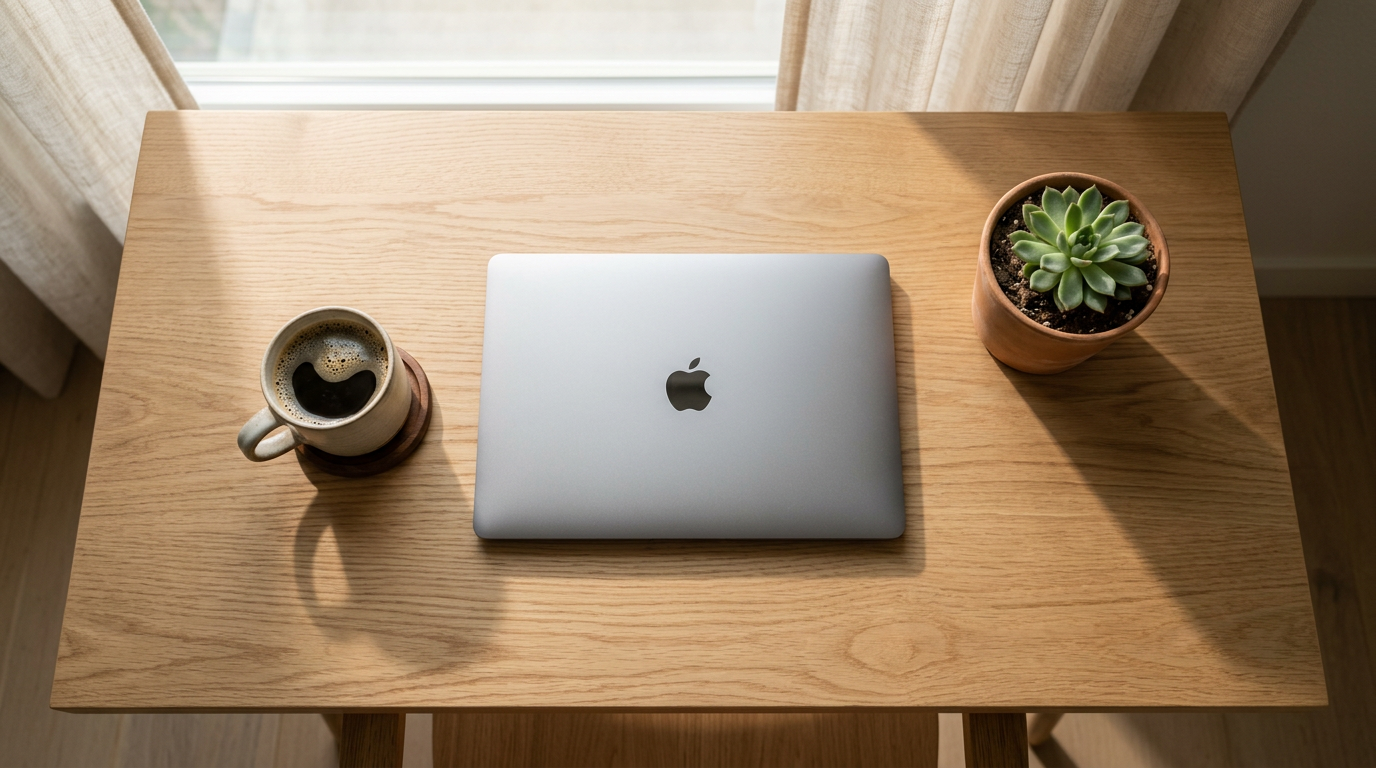
The desk tells you everything about the mind working at it.
Too much on it, and you're not building. You're managing. Clutter is not a personality. It's a tax.
The Paradox of More
Three monitors. A phone stand. A ring light. Two keyboards "just in case." A smart speaker answering questions no one asked.
This is not a workspace. This is a control room with no mission.
Here is the uncomfortable truth: research shows that beyond a certain threshold, additional screen real estate stops serving the work and starts serving the ego of having a setup. A 2021 systematic review published in PubMed found that while dual monitors may increase task efficiency, they also result in nonneutral neck postures and a cascade of multitasking behaviors that fracture attention rather than sharpen it. The University of Utah's landmark study noted that productivity gains peaked at two 20-inch monitors and dropped again at a 26-inch single display. More surface area does not equal more depth of focus.
The paradox is this: the more screens you have, the more your brain believes it must monitor all of them simultaneously. You're not working. You're watching your own work happen from a distance.
The Psychology of Empty Space
A clear desk is not an aesthetic choice. It is a cognitive one.
Every object in your visual field competes for neural bandwidth. Studies cited by Nuvance Health describe clutter as a form of visual distraction that increases cognitive overload and reduces working memory capacity. Your brain does not simply ignore the stack of unread mail or the tangled cable in the corner. It registers each one, categorizes it, and files it away somewhere it cannot quite reach. This is why you feel tired before you've done anything difficult.
Empty space, by contrast, gives the prefrontal cortex permission to focus. It lowers the number of micro-decisions your brain makes per minute. It reduces what psychologists call decision fatigue, the slow erosion of willpower through accumulated small choices. A 2023 PMC study found that indecisive individuals experienced measurably greater negative cognitive impacts from cluttered environments than action-oriented ones.
The empty desk is not spartan austerity. It is respect for your own attention.
For deeper reading on how intentional spatial design shapes human behavior, Architectural Digest's "How to Design for the Modern Workplace" offers a sharp look at how contemporary designers are rethinking environments for cognitive performance, not just visual appeal.
Essential Gear vs. Digital Noise
Minimalism is not about owning less. It is about owning right.
There is a difference between a workspace stripped of meaning and one stripped of distraction. The former feels punishing. The latter feels like flight.
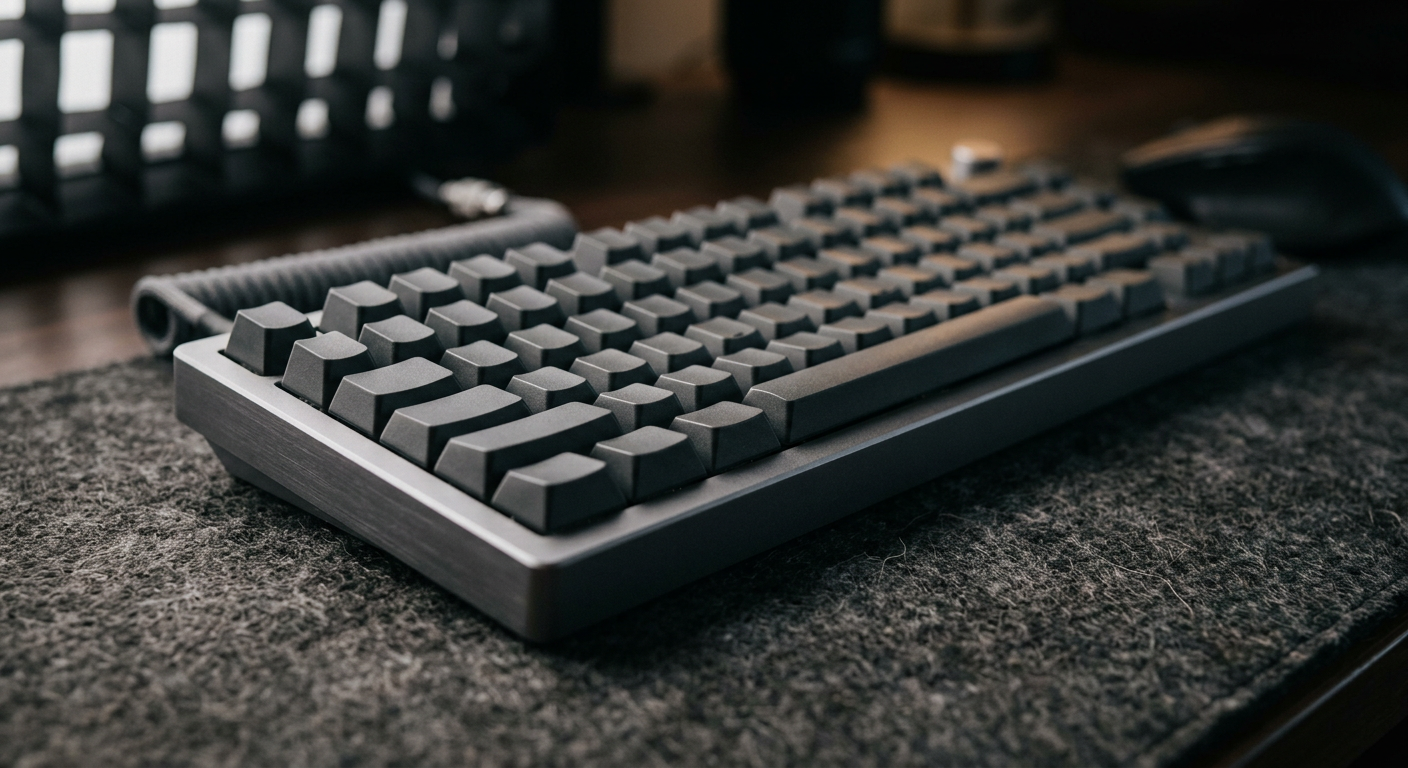
The keyboard matters more than people admit. A quality mechanical keyboard, something with clean tactile feedback, like a Keychron or a Leopold, creates a physical ritual around writing. The resistance of the keys, the sound, the intentionality of the strike: it slows you down just enough to think before you type. That half-second pause is where most bad decisions get caught.
The e-ink tablet is the most underrated focus tool of 2026. Devices like the reMarkable Paper Pro, with its 11.8-inch Canvas Color display and distraction-free interface that supports no apps whatsoever, remove the browser, the notifications, the infinite scroll. You are left with a surface that only accepts thought. The Kindle Scribe Colorsoft offers a softer entry point, adding AI-assisted note summarization for those who annotate heavily. These are not gadgets. They are decisions about how seriously you take your own thinking.
The guiding principle: if a device can interrupt you, reconsider whether it belongs on the desk.
Intentional Lighting
Natural light is not optional. It is the baseline.
A workspace facing north or east, soft, indirect daylight without harsh afternoon glare, regulates your circadian rhythm, boosts alertness during the morning, and signals to your body that this is a place of work. Research published in Scientific Reports found that natural light remains superior for workplace performance, contributing to measurably higher energy levels than artificial substitutes.
As evening approaches, the logic inverts. Cool, blue-spectrum light keeps cortisol elevated past the point of usefulness. The solution is deliberate: warm lighting in the 3000K range. A study published in Nature Scientific Reports demonstrated that the combination of 3000K color temperature and 750 lux illumination produced the lowest mental workload scores across all tested lighting conditions, making it measurably better suited to sustained office work. A warm desk lamp with a color-adjustable bulb, shifted to 3000K after 5 PM, is not a luxury. It is a physiological signal that the day's hardest work is behind you, and reflective work begins.
The right light does not just help you see the work. It tells your brain what kind of work to do.
One Final Thought
The most productive workspace you will ever build is the one that makes it slightly harder to do anything other than think.